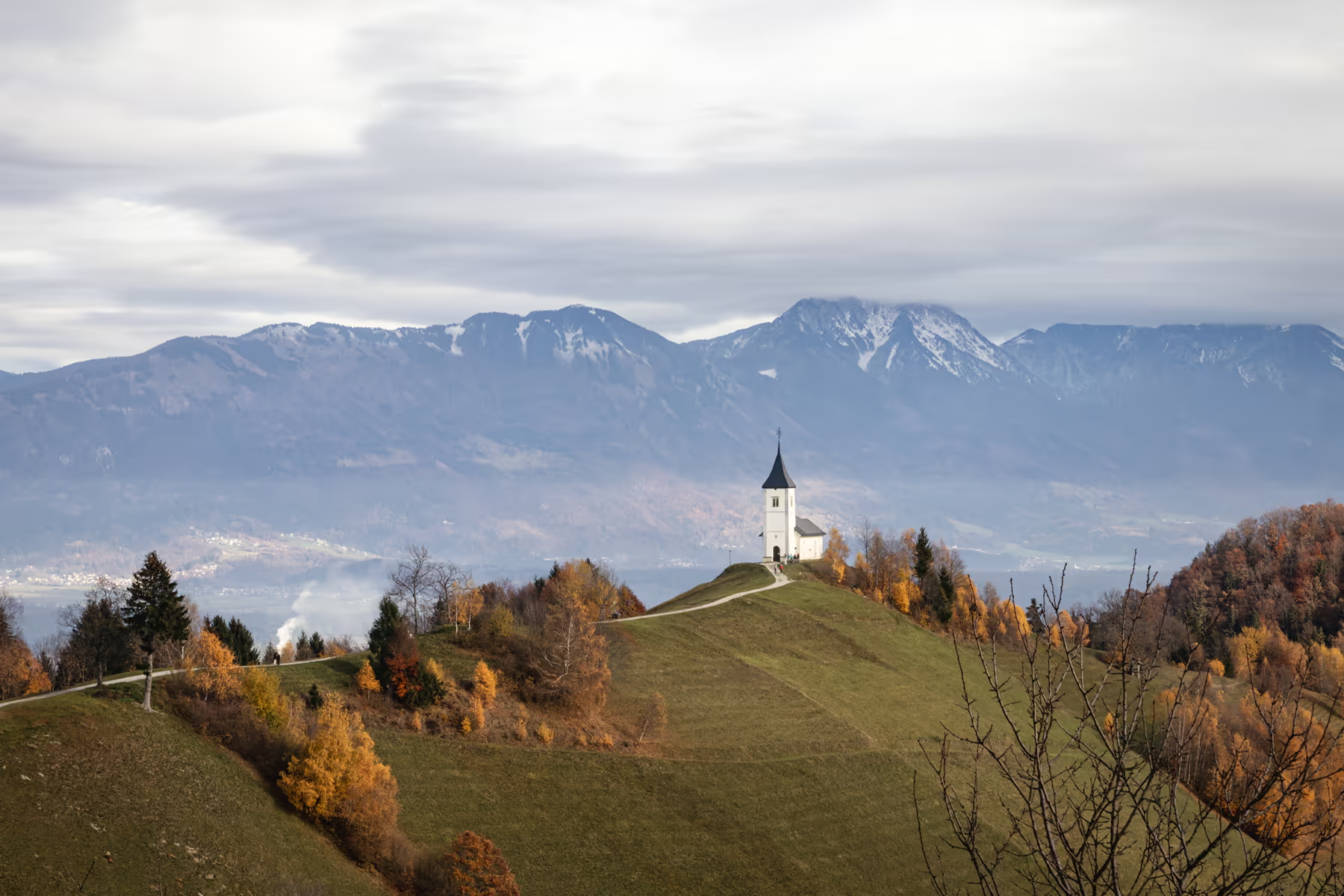
Jamnik, where photographers
wait for the light.
The little church of Sts. Primus and Felician on Jamnik above Kropa is one of the most photographed churches in Slovenia. It stands on a ridge at the edge of Jelovica, with views of the Kamnik–Savinja Alps, the Karavanke and the Škofja Loka Hills.
Its history goes back to the 12th century, and medieval frescoes are preserved inside. It is only a few minutes' drive from Dražgoše.
- The best lightAt sunrise and sunset.
- How to get thereBy car or bike to the village of Jamnik, then a short walk to the ridge. On foot from Kropa about an hour and a quarter along a marked forest path.
- ParkingOnly a few spaces by the road, so come early.
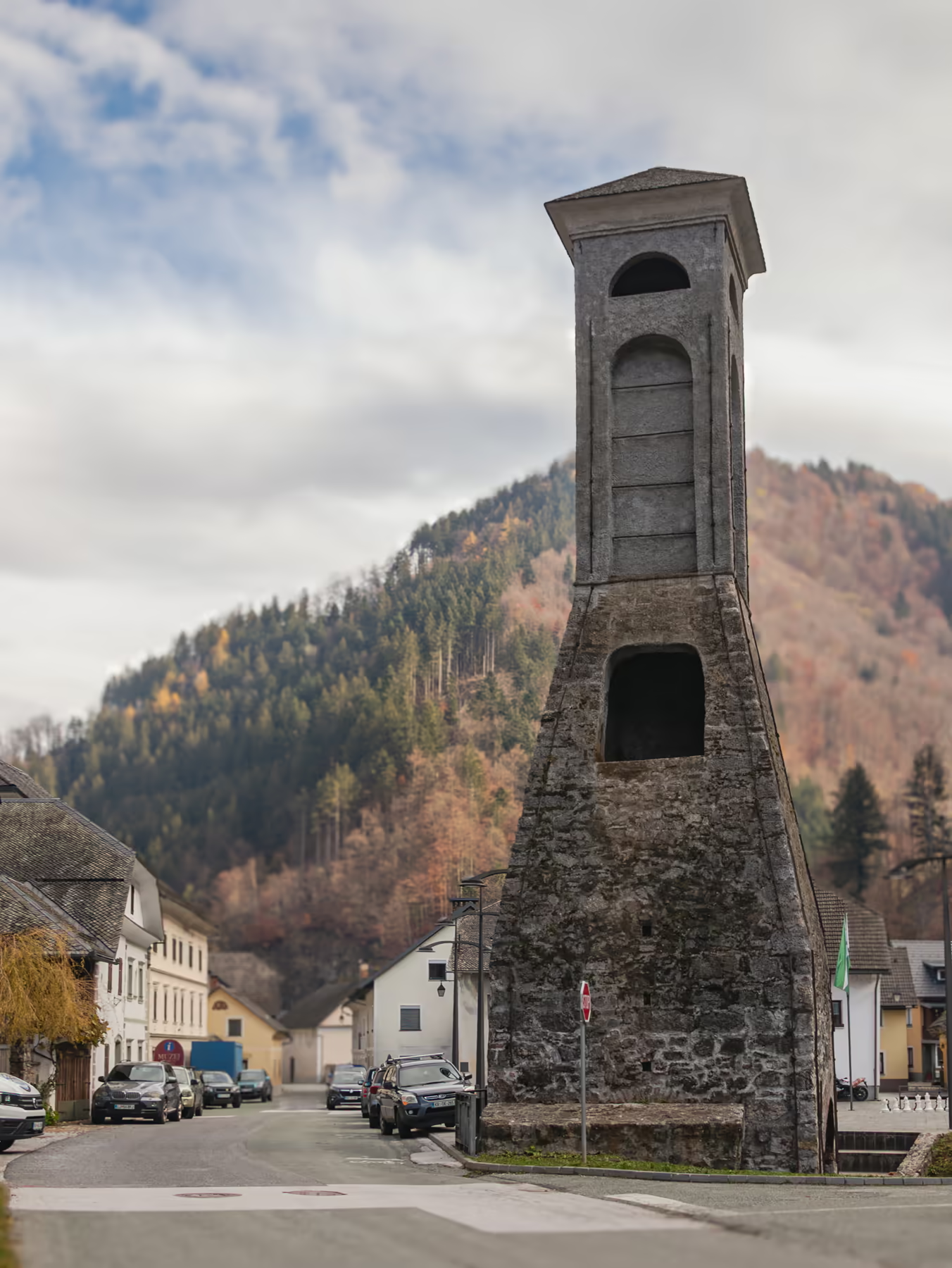
Železniki
and its blast furnace.
Železniki is the nearest larger town below Dražgoše. The town grew up around ironworking: for centuries iron was smelted here from Jelovica ore and forged into nails that were sold far across Europe.
A reminder of that time is the blast furnace in the town centre, one of the few preserved smelting furnaces in Slovenia and a protected technical monument. At the Železniki Museum you can learn about ironworkers, blacksmiths and lacemakers, as Železniki is also known for its lace.
The blast furnace in ŽeleznikiŽelezniki Museum
The museum is in the Plavec House from 1637, by the blast furnace in the town centre. The main collection presents six centuries of ironworking in the town.
Lace Days
Every summer Železniki turns into a festival of lace for a few days. It is the lace festival with the longest unbroken tradition in Slovenia, first held in 1962.
Grohar House
The painter Ivan Grohar, author of The Sower, was born in 1867 in Spodnja Sorica. His birth house holds a memorial collection with a gallery and an ethnological collection of village life.
Selca
Selca is one of the oldest villages in the valley, first recorded as early as 973. It was once the main settlement of the valley, which is named after it: the Selška Valley. The village has a parish church of St. Peter.
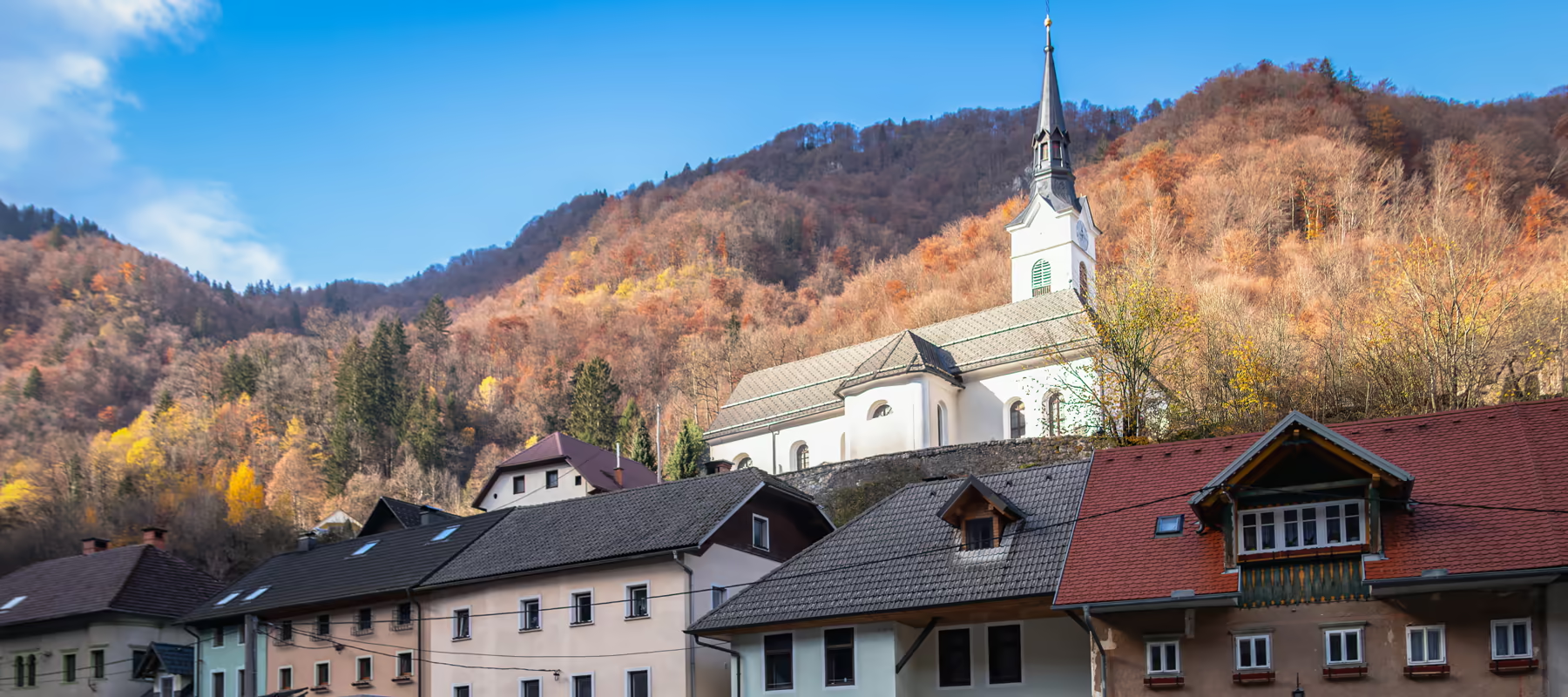
Kropa,
the cradle of Slovenian blacksmithing.
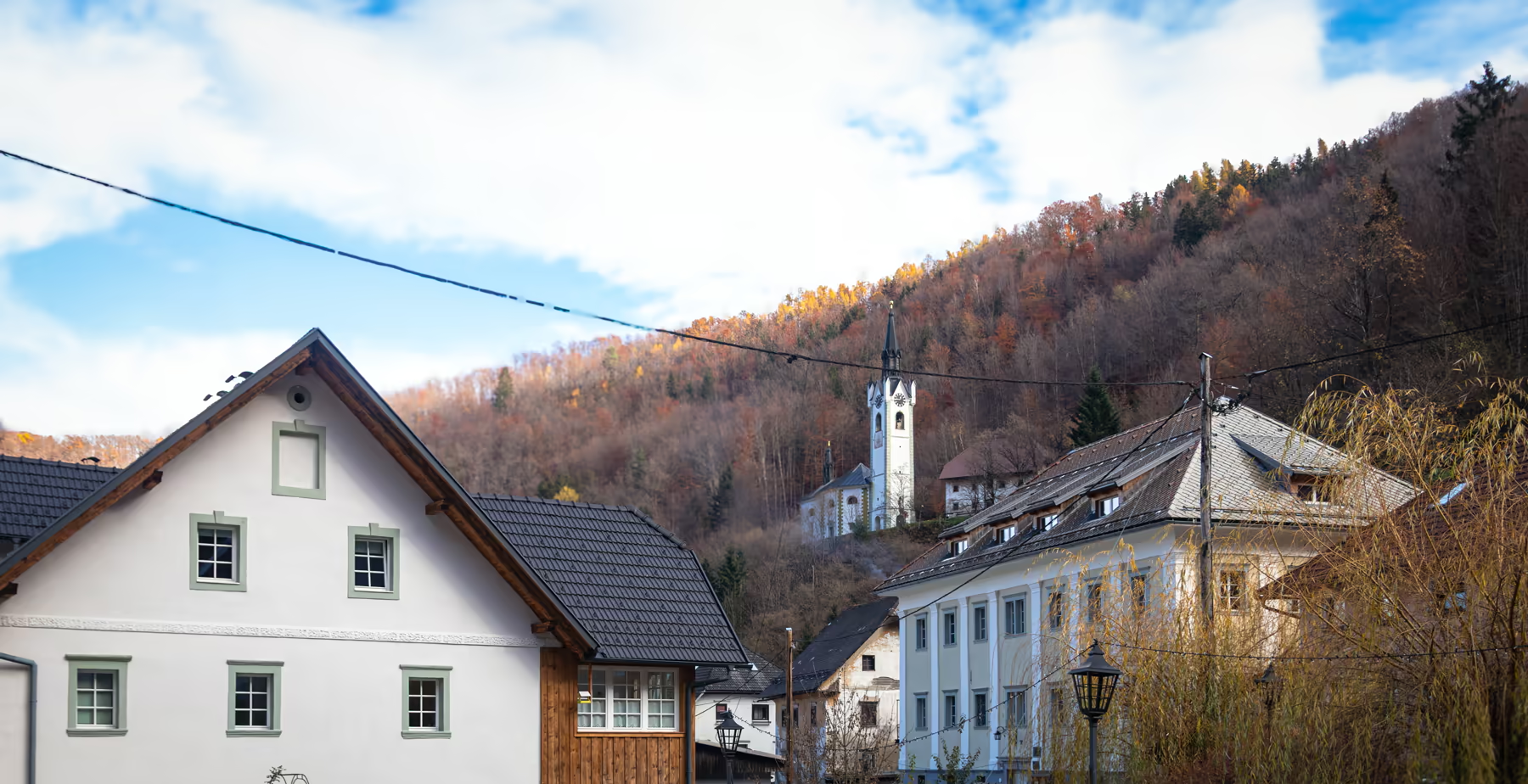
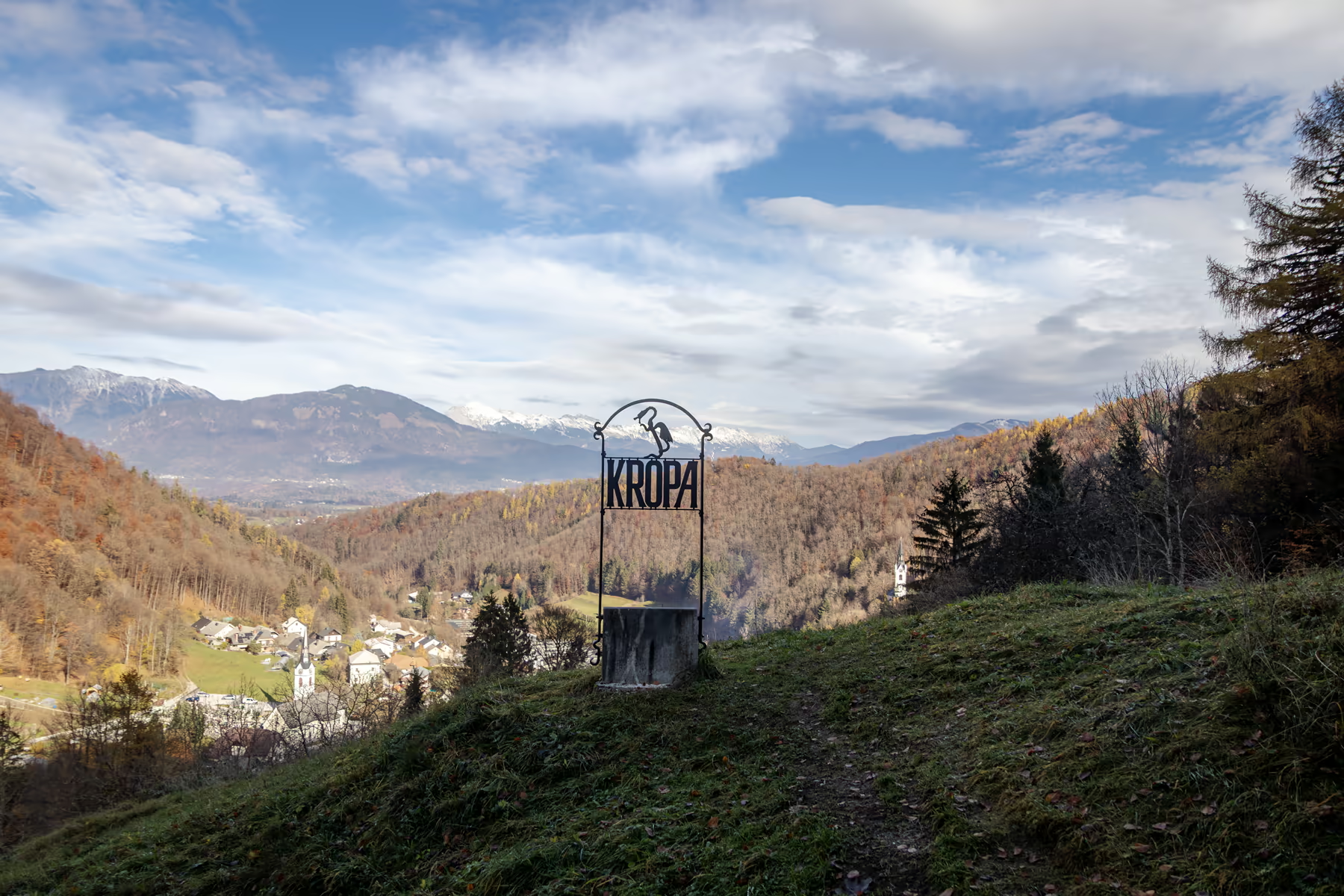
Kropa lies in the narrow valley of the Kroparica stream, on the other side of Jelovica; from Dražgoše you drive there past Jamnik. For centuries it lived from iron: in the forges along the stream, nails were made and shipped far around the world.
This story is told by the Iron Forging Museum and the Vigenjc Vice forge, and the old centre with its stone houses by the water is a protected cultural monument.
Iron Forging Museum
In a large ironmaster's house in the square, the museum tells of centuries of iron in Kropa and Kamna Gorica: blast furnaces, charcoal burners, nail makers and art blacksmiths. Next to it is Vigenjc Vice, an old forge where they still forge – one of the few left in Europe.
Blacksmiths' Festival
The biggest festival in Kropa, when the village comes alive with blacksmithing demonstrations and charcoal burning. It is organised by the Kropa Tourist Association.
The old centre
Stone blacksmiths' houses line the Kroparica, among them the Jurman House from 1710, the most photographed house in the village. The village also has the church of St. Leonard, and paths lead from Kropa up to Vodiška planina.
The Slovenian Furnace
The remains of a 14th-century iron smelting works, discovered in 1953, are the oldest monument of their kind in Slovenia. The three-metre furnace operated until the mid-15th century; today its remains are protected by a shelter.
Double hayracks
(toplar).
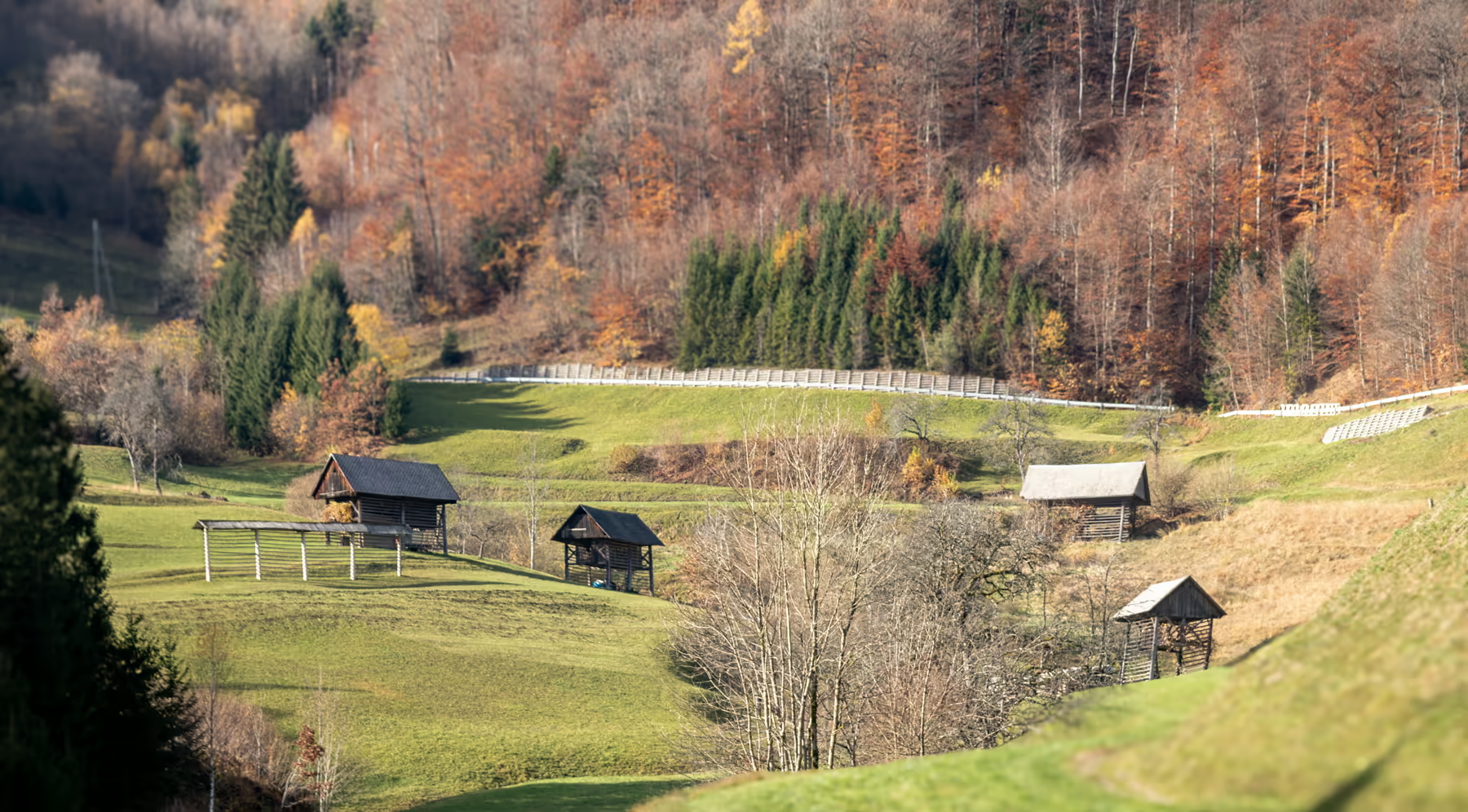
A group of wooden double hayracks in Podblica stands on a grassy slope just below the village, between the road into the village and the turn-off towards Jamnik. The hayracks are listed in the register of cultural heritage.
The road from Kranj through Besnica to Dražgoše passes through Podblica, so you can see them on your way to us.
Where to go
from Dražgoše.
Kropa
A blacksmiths' village with the Iron Forging Museum, the Vigenjc Vice forge and the Jurman House; the Blacksmiths' Festival on the first weekend in July.
Železniki
The nearest larger town, with the blast furnace in the centre, the Železniki Museum and the summer Lace Days.
Škofja Loka
A medieval town with a castle, the Loka Museum and the Stone Bridge.
Sorica
The birthplace of the painter Ivan Grohar, with Grohar House, a memorial collection and a gallery.
Radovljica
The old town on a terrace above the Sava, the Beekeeping Museum and the Gingerbread House.
Bled
A lake with an island and church, a castle on a cliff and the Vintgar Gorge.
Bohinj
Lake Bohinj, the Savica waterfall and gateways to Triglav National Park.
Ljubljana
The capital, with its castle hill, the Triple Bridge and a lively old town.
All the places
in one map.
- Dražgoše
- Trips
- Hiking
- Photo spots
- Paragliding
- Ski areas